Moonrise Dubai is a small, one-star chef’s table on the rooftop of Eden House in Al Satwa, led by Dubai-born chef Solemann Haddad. Dinner is a single tasting menu of around 12 courses that tells the story of growing up in the city. Recent guides list the menu at roughly AED 995 to 1,100 per person, with pairings extra, and a shorter six-course street food menu has been offered at AED 500. Service runs Tuesday to Saturday, and booking ahead is essential because the counter seats only 12 to 15 guests.
Moonrise Dubai: A Personal Culinary Story
Most tasting menus in Dubai start with an idea about ingredients or technique. Moonrise Dubai starts with a childhood.
Chef Solemann Haddad was born and raised in the emirate. He dropped out of university three weeks before graduating to pursue cooking, taught himself most of what he knows, and opened Moonrise in late 2021 while still in his twenties. Gault&Millau later described that first venture as extraordinary for a young local chef: a brave, confident and impressive move.
What he cooks is something he calls “Dubai cuisine,” a phrase he has repeated often. The Khaleej Times quoted him saying he always tells guests, “this is Dubai cuisine.” It doesn’t mean Emirati food in the traditional sense. It means the way the city actually eats: Lebanese bakeries, Indian cafeterias, Japanese influences, American fast food, mall food courts, all the cultures colliding in a place where almost everyone comes from somewhere else.
That makes Moonrise a rarity among fine-dining restaurants in the UAE. It is a home-grown, chef-owned concept where the story on the plate belongs to someone who grew up here. The restaurant holds one Michelin star, was retained in the Michelin Guide Dubai 2025, and has collected other recognition: Gault&Millau’s three toques, a place on the MENA 50 Best list (a 2025 review noted it ranked 10th), and Time Out Dubai’s award for best tasting menu experience in 2024.
This guide covers what to expect: where Moonrise is, what the room feels like, how the menu works, what it costs in dirhams, and how to book. It’s written for readers in the UAE who want practical answers before spending a serious amount on dinner.
How this guide was put together: it draws on the Michelin Guide, press coverage, awards listings and published reviews, not a personal visit. Prices and menus change often at Moonrise, so confirm details with the restaurant before booking.
Where to Find Moonrise in Al Satwa
Moonrise sits on the roof of Eden House, 41 Street, Al Satwa, Dubai. One reviewer described the setting as a 31st-floor roof deck of an apartment building, with the lights of the Burj Khalifa twinkling in the middle distance. The Michelin Guide describes it as perched on the roof of a smart residential building.
Al Satwa is an interesting address for a tasting-menu restaurant. It’s one of Dubai’s older, more characterful neighborhoods, known for its cheap eateries, tailors, shawarma shops and a mix of nationalities. A restaurant of this level on a residential tower there feels deliberate, and fits Haddad’s focus on everyday Dubai.
Getting there:
- By taxi or ride-hailing: The easiest route from most parts of the city. Share the building name, Eden House, and the street, 41 Street, with your driver.
- By car: Ask the restaurant about parking when you book, since Satwa’s streets can be tight in the evening.
- Entrance: The restaurant is on the top floor of a residential building, so you’ll take a lift up. Allow a few extra minutes to find the entrance on your first visit.
Timing tip. Moonrise serves everyone together, and the Michelin Guide specifically advises arriving on time, because all guests start the meal at once. Traffic along Sheikh Zayed Road and into Satwa can be heavy on Thursday and Friday evenings. If you’re coming from Downtown or Dubai Marina, leave early.
The Restaurant’s Intimate and Relaxed Atmosphere
Moonrise doesn’t feel like a traditional fine-dining room, and that’s the point. The restaurant is small, with a counter that seats 12 to 15 guests depending on the source and the date. Gault&Millau describes the space as minimal, restrained and profoundly local.
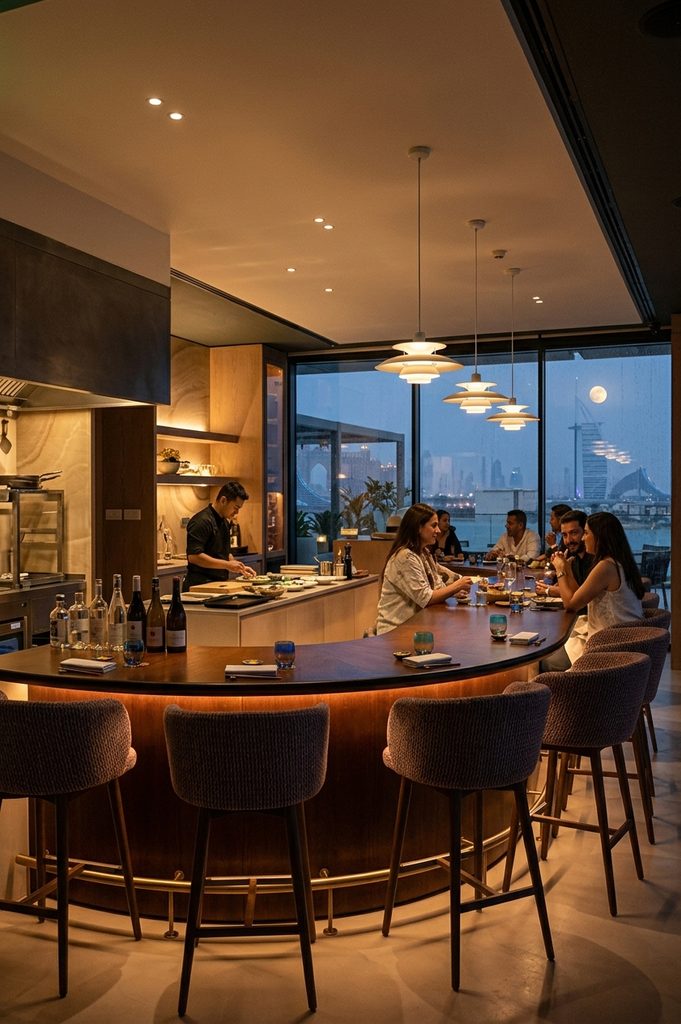
The view. Wall-to-wall windows overlook the Dubai skyline, according to the World’s 50 Best Discovery listing. A reviewer who visited in 2025 noted the combination of city lights and a light breeze on the roof deck as a dream setting. Because the restaurant is air-conditioned, as noted in its Michelin listing, you can enjoy the skyline year-round without worrying about summer heat.
The counter. Guests sit around a chef’s counter and watch the team prepare each course. The setup creates a friendly, close atmosphere. Haddad is known for explaining his dishes, their origins and even how they’re made. The Michelin Guide specifically describes him as an eloquent, passionate and thoughtful chef who is happy to explain his dishes.
The mood. Expect a relaxed, personal evening rather than formality. Because the menu tells stories from his childhood, the conversation at the counter tends to be warmer and more informal than at a hushed tasting room. A Michelin inspector noted being taken by the warmth of the welcome.
Who it suits. Couples, small groups of friends and solo diners who like talking to the chef. If you prefer a private table, this is a different experience. Everyone eats together, at the same pace, with the same story unfolding.
Practical points:
- Seating is first-come within the booking time, so arrive early if you want a particular spot.
- Small group bookings can take over a large part of the counter.
- The licensed restaurant serves wine, and there are non-alcoholic options too (see the pairing details in the prices section).
Moonrise Dubai Menu: A Journey Through Flavour
Moonrise serves one tasting menu, not an à la carte list. The Michelin Guide calls it a “surprise” menu, and that is the right frame of mind. You don’t choose the courses. You put your trust in the chef and let the evening unfold.
Structure. Recent guides describe a menu of 11 to 12 courses. A Time Out Dubai listing noted 11 to 12 courses with 12 listed on the price line. A Gault&Millau profile described a 12-course journey that’s as much about narrative as flavor. Expect a gentle build from small, bright openers through richer middle courses to a series of desserts.
The cuisine in a sentence. Moonrise blends Middle Eastern ingredients with Japanese techniques. The Michelin Guide praises him for bringing alive top-quality Middle Eastern ingredients and flavors through the clever use of Japanese notes and techniques. Gault&Millau adds that the menu draws on influences from Japanese robata to Indian street food, American classics and even guilty pleasures from mall food courts.
Sourcing. The World’s 50 Best Discovery listing notes that Moonrise sources locally from within the Middle East wherever possible, importing specialist produce only when truly necessary. The Michelin Guide’s description of Haddad’s philosophy is similar: use homegrown ingredients and fill in gaps with produce from around the world.
A seafood-friendly menu. The 50 Best listing mentions the best of global seafood, so fish and shellfish appear often. If you or your guests have dietary needs, tell the restaurant when you book. Because the menu is a fixed sequence, changes are limited, but advance notice helps.
The short menu. For guests who want a lighter, lower-priced experience, Moonrise has also launched a six-course street food menu, described later in this guide.
Timing. Plan for two to three hours. Michelin lists two dinner sittings, and Time Out Dubai has noted 6:30 PM and 9:30 PM starts. Arrive on time, because the meal moves together.
Chef Solemann Haddad’s Creative Approach
Understanding Haddad’s approach makes the menu easier to enjoy. A few ideas run through it.
Memory as a starting point. He builds dishes around moments from growing up in Dubai, in particular the culture clashes of the 1990s. Time Out Dubai described the 12-course menu as drawing on those childhood memories. A dessert like the Abood juice cheesecake, made with Alphonso mango, brown butter and local honey gel, is meant to evoke the cafeteria culture of old Dubai. Abood’s juice shops are a staple memory for many residents.
Japanese technique as a language. Haddad describes his Japanese methods as self-taught. He uses them to cook Middle Eastern produce with precision, so a hamachi slice might arrive with Syrian sumac sauce and preserved lemon, as the 50 Best listing describes.
Humor and play. The grilled cheese on the menu is a famous example. It has stayed through several menu changes, and Time Out Dubai even reassured readers at one launch that the grilled cheese was still available. It’s a serious restaurant with a sense of humor.
Reinvention. Haddad has talked openly about reinvention as a core part of the project. When he launched the six-course street food menu, he called it a nostalgic homage to the streets and flavors he grew up with, and described it as a reinvention of Moonrise for the moment. Because the menu changes regularly, a return visit may bring a very different experience.
Rejecting labels. One Time Out Dubai writer noted that the latest menu feels less about fine-dining labels and more about capturing how the city eats. That’s a good summary of his attitude: the restaurant is a Michelin-starred place, but the heart of it is everyday food.
Recognition that backs it up. Haddad received the Michelin Young Chef Award Dubai in 2022 and Gault&Millau’s Future Great award the same year. Those early honors helped establish him as a serious voice, not just a young talent.
Moonrise Dubai Prices and Tasting Menu Details
Moonrise is a splurge, and the price has climbed since opening. Gault&Millau notes that tasting-menu prices have doubled since the restaurant’s inception, even though the overall experience has stayed largely unchanged. Below is what published sources have reported.
| Experience | Reported price (AED per person) | Notes |
|---|---|---|
| Main tasting menu (about 12 courses) | 950 | Reported in an earlier Time Out Dubai piece |
| Main tasting menu | 995 | Reported in a Time Out Dubai guide and a May 2025 review |
| Main tasting menu | 1,100 | Listed in a 2026 tasting-menu roundup |
| Main tasting menu (US dollars) | From about $299 | World’s 50 Best Discovery listing |
| Six-course “Dubai cuisine” street food menu | 500 | Launched on May 6, per Time Out Dubai and Gault&Millau |
Pairings. Drinks add a lot to the total. From the sources:
| Pairing | Reported price (AED) | Source note |
|---|---|---|
| Wine pairing, standard | 950 | May 2025 review |
| Wine pairing, premium | 1,750 | May 2025 review |
| Grape pairing | 1,300 | Earlier Time Out Dubai listing |
| Non-alcoholic pairing | 550 | May 2025 review |
| Half wine, half non-alcoholic | 700 | May 2025 review |
What a dinner for two costs (estimates from the figures above).
| Scenario | Estimated total for two |
|---|---|
| Tasting menu only, no drinks | About AED 2,000 to 2,200 |
| Tasting menu with non-alcoholic pairing | About AED 3,100 to 3,300 |
| Tasting menu with standard wine pairing | About AED 3,900 to 4,100 |
| Tasting menu with premium wine pairing | About AED 5,700 and above |
| Six-course street food menu, no drinks | About AED 1,000 |
These are calculations, not quoted bills. Taxes and service charges may be added on top, so ask whether quoted prices include them.
Reading the numbers. The price spread across sources reflects both time and menu changes. The AED 950 figure comes from an earlier period, and the 995 and 1,100 figures from later ones. Treat AED 1,100 as the most current published figure, and confirm before booking.
Value check. A Time Out Dubai feature once placed Moonrise in a list of tasting menus under AED 1,000, back when it was priced at 995. At AED 1,100, it has moved just above that line. The six-course street food menu at AED 500 is notable because it halves the entry price while keeping the chef’s counter format.
Memorable Courses and Unexpected Combinations
Menus rotate, so this is a snapshot of dishes reported across reviews and listings rather than a guaranteed list. What matters is the style.
Hamachi with Syrian sumac sauce and preserved lemon. Described by the 50 Best listing, the hamachi arrives in uniform slices, dressed with a tangy sumac sauce. It is a good example of Japanese slicing meeting Levantine seasoning.
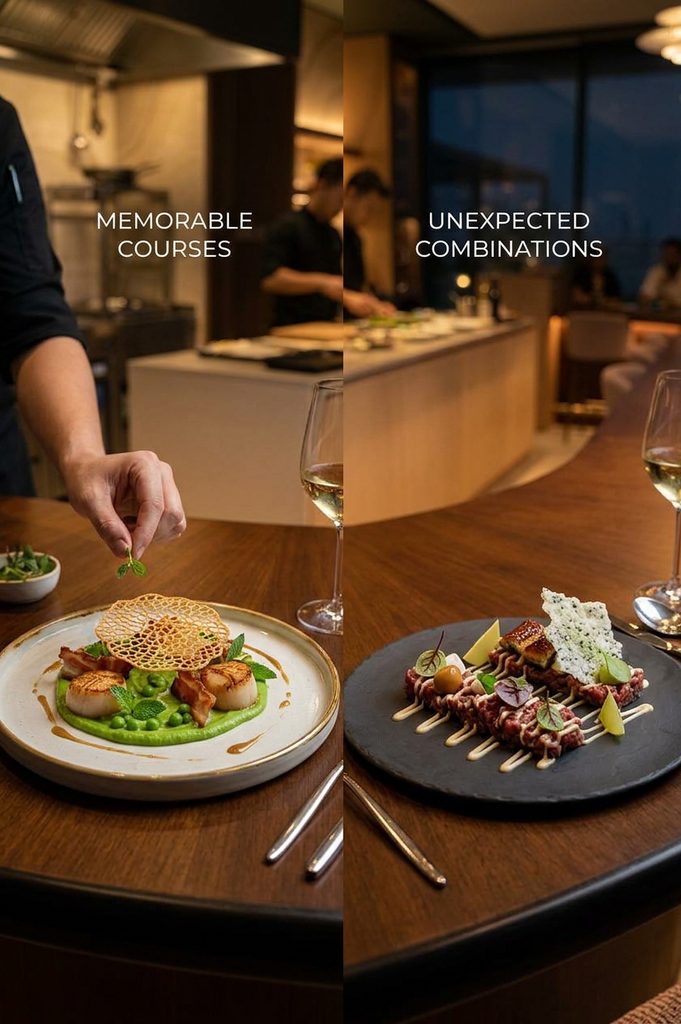
Khoory kabab. A dish using A5 Wagyu beef reared in Jordan, served with celeriac, beef jus and a shiso bouquet, according to the 50 Best Discovery. It sums up the restaurant’s approach: a Middle Eastern ingredient, a Japanese flourish, a very Dubai name.
Grilled cheese. A signature that has survived multiple menu changes. It plays on the comfort-food side of the restaurant, and Time Out Dubai described it as a fancy take.
Turbot. A 2025 reviewer called the turbot dish amazing and one of the true standouts of the meal.
Kumquat ceviche. Mentioned in a 2026 tasting-menu roundup as part of the current line-up.
Abood juice cheesecake. Alphonso mango, brown butter and local honey gel, evoking the cafeteria culture of old Dubai.
Muskmelon and labneh dessert. A newer dessert reported alongside the cheesecake.
Non-alcoholic pairings. One reviewer described an amazing strawberry daiquiri, sweet, tangy and foamy, as one of the best mocktails they’d ever had. If you’re skipping alcohol, the non-alcoholic pairing sounds like a real option rather than an afterthought.
The street food menu. The six-course menu draws on dishes like shawarma, Malabar paratha, Chips Oman, pani puri and karak. Each course arrives with a printed card that traces where the dish comes from, including the specific restaurant or café in Dubai where you can try the original. That detail turns the meal into a guide to the city’s food map, and it’s a nice way to continue the experience after dinner.
How to approach a surprise menu. Eat as each course arrives, ask questions about ingredients, and let go of expectations. The pleasure comes from how flavors collide, like a spicy, creamy, crunchy bite that tastes like a food court and a fine-dining plate at the same time.
The Inspiration Behind Moonrise’s Food
If you want to understand the food, think about Dubai in the 1990s and early 2000s, the city Haddad grew up in.
A city of many kitchens. In Dubai, a school lunch might be a Lebanese manakish, a Pakistani biryani or an Indian samosa. After school, you might stop for fresh juice or a karak chai. On weekends, family dinners might be at a Filipino, Iranian or Egyptian restaurant. Haddad describes his cuisine as the product of these overlapping influences.
Street food as a starting point. The newest menu reflects this directly, with dishes inspired by shawarma, paratha, Chips Oman (a classic Dubai snack sandwich), pani puri and karak. It reads as a love letter to the places most residents eat at least weekly.
Mall food courts and fast food. Gault&Millau notes that his repertoire includes guilty pleasures from mall food courts and American classics. For anyone who grew up in the UAE, those references land.
Japanese discipline. The Japanese influence comes through precision, restraint and the omakase format. Michelin notes Haddad is one of the first to use Japanese notes and techniques to bring Middle Eastern ingredients to life.
Local sourcing. The restaurant prioritizes ingredients from the Middle East whenever possible, which is meaningful in a city that imports most of its food. That focus links the menu to the region rather than only to the city’s global kitchen.
Family and place. Haddad has spoken about how much the award meant to him because of his roots. The restaurant is a personal project, and that sense of ownership shows in the way the menu is introduced and explained.
For visitors to the UAE, Moonrise offers something unusual: a window into how residents eat, translated into a serious tasting menu. For long-time residents, it offers recognition, because many of the references are everyday memories.
Moonrise Dubai Reservations and Visiting Tips
How to book. Michelin’s page notes that its own booking tool isn’t available for Moonrise, so book directly. The restaurant’s contact number listed by several guides is +971 50 697 2946, and its website is moon-rise.xyz. Check the official site for the current booking system, since small restaurants sometimes release tables in batches.
Opening days and times. Based on published listings:
- Michelin lists dinner Tuesday to Saturday, from 6 PM to midnight, with Sunday and Monday closed.
- Time Out Dubai has listed two sittings, at 6:30 PM and 9:30 PM, Tuesday to Saturday.
- The World’s 50 Best Discovery page lists dinner Tuesday to Saturday.
Confirm current sitting times and days when you book.
Be on time. Because all guests are served together, the Michelin Guide specifically advises arriving on time. A late arrival disrupts the whole counter.
Dress code. I could not find an official dress code. The restaurant has a relaxed atmosphere, so smart casual is a safe approach. Because you’ll be on a rooftop in a residential building, you don’t need formal wear, but avoid beachwear and sportswear for dinner.
Dietary needs. Tell the team about allergies, dietary restrictions and strong dislikes when you book. With a fixed menu and a tiny team, flexibility is limited, so earlier notice helps.
Drinks. The restaurant is licensed, according to a Time Out Dubai listing and Gault&Millau, which notes it is now fully licensed. A non-alcoholic pairing is available if you prefer to skip alcohol.
Practical checklist:
- Book as early as possible, especially for weekends.
- Confirm the current menu and price (full tasting menu or the six-course option).
- Decide on a pairing in advance.
- Allow two to three hours.
- Check parking or drop-off at Eden House.
- Ask about deposits and cancellation terms.
- Confirm the restaurant’s current schedule and any seasonal pauses, which are common among small Dubai restaurants.
A note on status. In early October 2026, several Michelin-starred Dubai restaurants were reported as temporarily closed, though Moonrise was not named on the lists I found. I could not confirm its status beyond published listings, so verify that it is open before planning your evening.
What Makes Moonrise Different from Other Dubai Restaurants?
Dubai has many serious tasting menus. Moonrise stands apart for a few reasons.
It’s personal. Many high-end restaurants in the UAE are outposts of international brands or hotel projects. Moonrise is a chef-owned restaurant by someone who grew up in the city, and it tells a story only he could tell.
It’s local in meaning, not just ingredients. Some restaurants use local produce but present food from elsewhere. Moonrise starts from Dubai itself, including its street food, cafeterias and multicultural mix.
It’s intimate. With 12 to 15 seats, a counter format and the chef explaining his dishes, the experience feels closer to a dinner party than a formal service.
It mixes high and low. Grilled cheese, shawarma-inspired courses and food-court nostalgia sit beside A5 Wagyu and turbot. It treats comfort food with the same respect as luxury ingredients.
It keeps changing. The menu has been reworked several times, and the six-course street food menu shows that the restaurant is willing to experiment with format and price.
How it compares with other Dubai tasting menus.
| Restaurant | Style | What sets it apart |
|---|---|---|
| Moonrise | Dubai-born chef, Middle Eastern and Japanese blend | Personal storytelling about the city |
| Hōseki | Edomae omakase | Traditional sushi counter at Bulgari Resort |
| Smoked Room | Fire Omakase | Smoke-driven cooking by a Spanish chef |
| Al Muntaha | French-based fine dining | Burj Al Arab setting and views |
If you want a formal, classic dining room, other options will suit you better. If you want food with a point of view, delivered by the person who created it, Moonrise is one of the most distinctive tables in the UAE.
FAQs About Moonrise Dubai
1. Where is Moonrise Dubai?
On the rooftop of Eden House, 41 Street, Al Satwa, Dubai.
2. Who is the chef behind Moonrise?
Solemann Haddad, a Dubai-born, largely self-taught chef who opened the restaurant in 2021.
3. Does Moonrise have a Michelin star?
Yes. It holds one Michelin star, which it retained in the 2025 guide. Chef Haddad also won the Michelin Young Chef Award Dubai in 2022.
4. How much does the tasting menu cost?
Recent guides list it between AED 995 and AED 1,100 per person. A six-course street food menu has been offered at AED 500. Confirm current prices.
5. How many seats are there?
Sources list between 12 and 15 seats at a chef’s counter.
6. What kind of food does Moonrise serve?
Creative “Dubai cuisine,” blending Middle Eastern ingredients with Japanese techniques and influences from the city’s multicultural food scene.
7. What are the opening days?
Tuesday to Saturday, with dinner sittings in the evening. Sunday and Monday are listed as closed.
8. Are there non-alcoholic pairings?
Yes. A non-alcoholic pairing and a half-and-half option have been reported alongside wine pairings.
9. Is there a dress code?
No official code was found. Smart casual is a safe choice.
10. How do I book?
Book directly through the restaurant’s website or by phone. The Michelin Guide’s own booking tool does not cover Moonrise.
Final Thoughts
Moonrise Dubai works because it knows exactly what it wants to say. Chef Solemann Haddad isn’t trying to recreate European fine dining or import a foreign concept. He’s cooking the city he grew up in, with Middle Eastern ingredients, Japanese discipline and a sense of humor that makes a grilled cheese feel as important as Wagyu.
The practical picture is straightforward. Expect a roughly 12-course tasting menu priced around AED 995 to 1,100, a six-course street food option at AED 500, optional pairings that can double the bill, dinner Tuesday to Saturday, and a tiny counter that books up fast. Arrive on time, tell the team about dietary needs, and go in curious.
If you want a formal, white-tablecloth dinner, this may not be the right fit. If you want food with a personal story, a rooftop skyline view and a chef who enjoys explaining his thinking, Moonrise remains one of the most original dining experiences in the UAE.

I’m passionate about food and the rich culture of the UAE. I’ve spent years exploring authentic Emirati dishes and diverse cuisines from across the region. Through Habibi Menus, I want to make it easy for everyone to discover real restaurant menus, learn about traditional flavors, and enjoy the best food the UAE has to offer. I focus on sharing clear, simple, and helpful information so everyone can understand and enjoy the local food culture. When I’m not working on the site, I love visiting new restaurants and trying different dishes with my family and friends.